Showing posts with label satellite. Show all posts

April 01, 2022

Leveraging Satellite Communications in Business


During last week’s Satellite 2022 conference, panellists discussed the possibilities for AI-powered satellite connectivity such as accelerating digital transformation, edge computing, and the enterprise IoT market. Satellite communications are intersecting with cloud services and other technologies which increase the data analytics and infrastructure possibilities in the future. For example, low orbit micro-satellites could provide a cost-efficient way to move data across the globe, and AWS are working with satellite developers to provide ground stations to downlink its growing data.

Through artificial intelligence and dynamic bandwidth allocation, satellite services may become more rapidly utilised by enterprises to increase their customer reach and accelerate their digital transformation. Nokia has started to provide consulting services in this sector and argues there are 3 pillars that organisations should focus on to enable this transformation. The first is obviously having a high-performance network layer via satellite, wireless, or wireline. The other 2 include analytics with AI and ML to analyse the factors that matter, and using digital devices to properly collect the data in the first place.

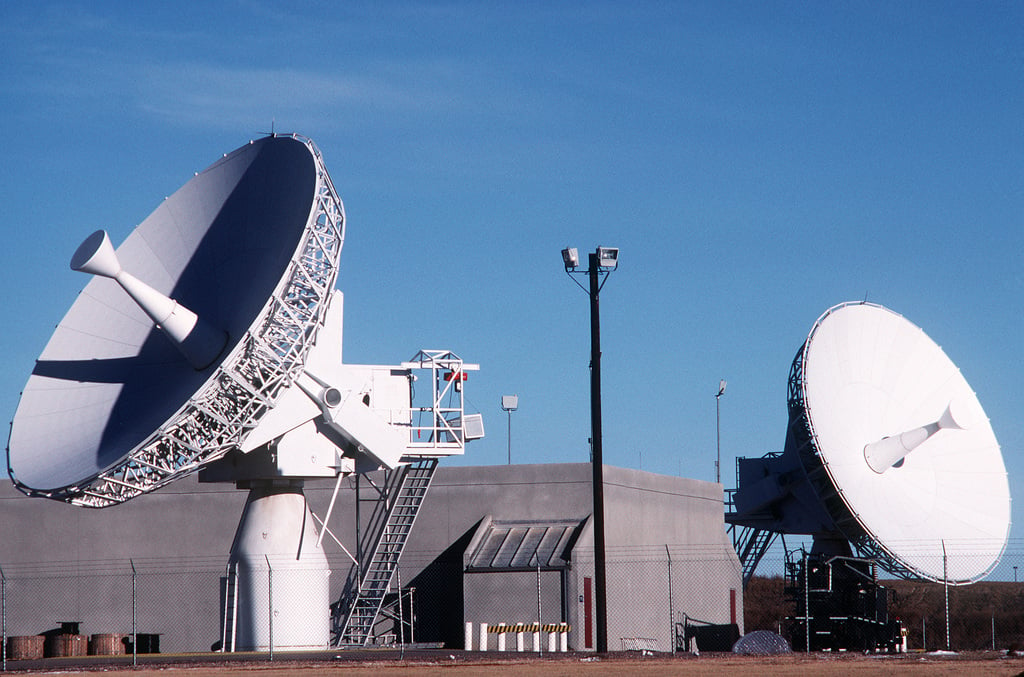
Satellite Dish Antenna Telecommunications

In order to digitise for transformation, everything must be digitised via an IoT sensing layer because collecting this data is useless if intelligence isn’t applied to it. In other applications, enterprises can connect to remote offices and locations using satellite technology. This is especially true for the mining, oil, and gas industries where locations may be quite disparate. Growth in IoT could significantly impact those industries wishing to harness the power of satellite communications by providing control and a visualisation of the enterprise’s operations.

The service should become more user-friendly as more data flows through these satellite networks, and the agriculture and healthcare sectors have also been seen as areas where this transformation could be highly beneficial. The use of AI will be critical to the success of IoT and thus the market for satellite communications moving forward.

US Communications Provider Targeted by Russia


Viasat, a US satellite communications provider, recently experienced a cyberattack in February that led to service outages across central and Eastern Europe, along with disconnecting remote access to around 5,800 German wind turbines. It has now come to light that this attack was likely the result of wiper malware named “AcidRain” according to researchers at SentinelLabs. This malware was designed to erase exploitable routers and modems remotely. It wipes the filesystem and storage devices and then tries to destroy that data. After this is complete, the device is rebooted and rendered useless.

Satellite Communications System

AcidRain’s functionality is relatively simple and generic and appears to use a bruteforce attempt that signals the attackers seemed inexperienced or unfamiliar with their target or simply wanted to keep their tool reusable. The attacker’s identity is still unknown, but there are many similarities between this malware and the “VPNFilter” malware which, in 2018, the FBI attributed to a Russian-backed hacking group known as APT28. More recently, this malware was also linked to another group known as Sandworm which is notorious for its “NotPetya” malware. Both groups have been tied to Russia’s military intelligence agency, the GRU.

Viasat was able to confirm the researcher’s findings and said they were consistent with the facts provided in their own report. This report goes into more detail about the attack and explains the attackers exploited a misconfigured VPN appliance to gain remote access to the trusted management segment of their network. This allowed the attackers to execute their destructive commands remotely.

The outage has still not been fully resolved and Viasat has since shipped 30,000 modems to their affected customers. CISA have warned that US satellites may be the next target. AcidRain is potentially the seventh wiper malware to target Ukraine since the start of Russia’s invasion.